


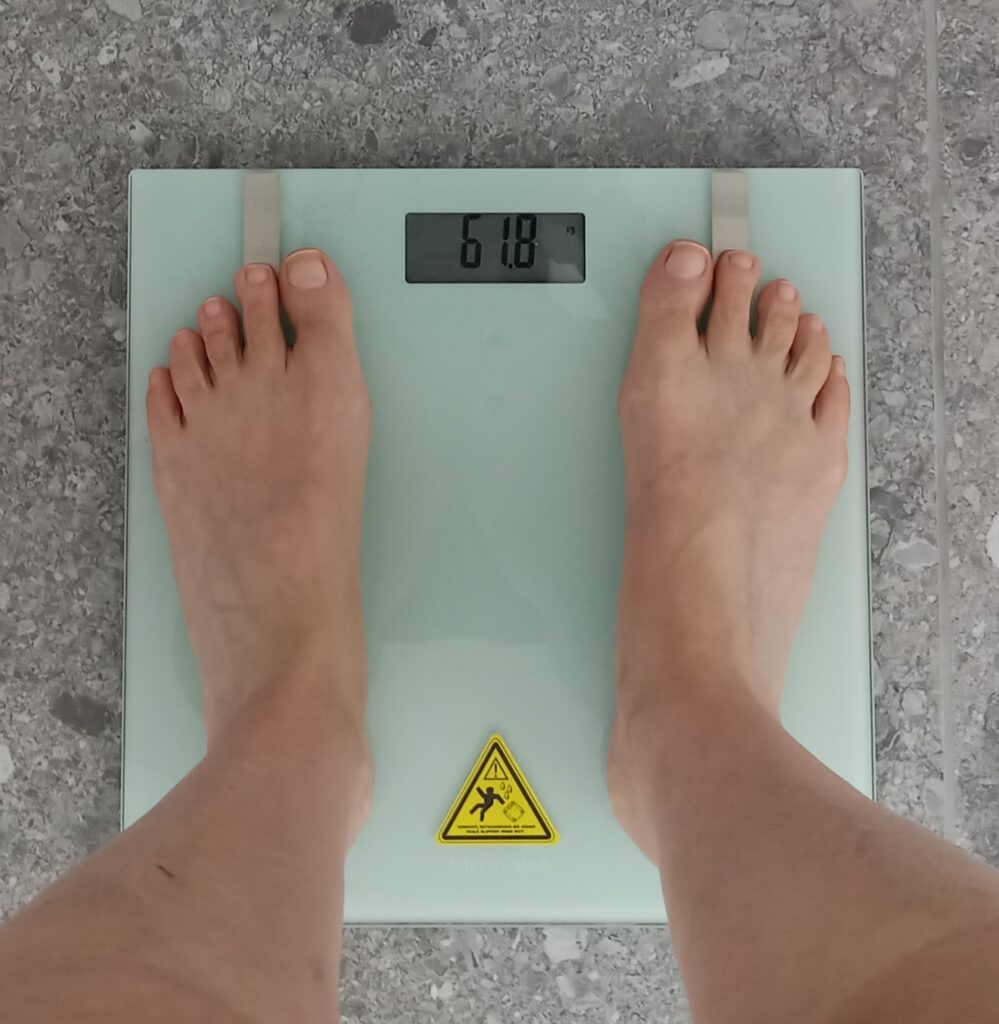
The scale is the worst available tool for tracking real progress. It’s also the most used.
It’s also the wrong thing to measure in most cases — and choosing the wrong measure guarantees the wrong feedback on what is actually happening.
I work with women who are doing everything right: eating well, training consistently, moving more. They weigh themselves every morning and feel like failures because the number hasn’t moved. The number was never the right measure. That’s the problem.
The devil is in the details. Choose the wrong measure, get the wrong feedback. And wrong feedback makes women stop doing the things that are actually working.
What the scale actually shows
Weight is a composite number: fat, muscle, water, food still in the digestive system, bone density. When the scale goes up by a kilogram on a Tuesday morning, it doesn’t mean the work is failing. It means something. Almost certainly not what you think.
Women in perimenopause and beyond experience significant water retention fluctuations from hormonal shifts. The scale captures all of it without distinguishing anything. A kilogram of fat and a kilogram of water look identical. Research on body composition measurement in women over 45 has consistently shown that body weight alone is insufficient to evaluate fat loss progress, and that composite measures give a meaningfully more accurate picture of real change.
Resting heart rate
A direct window into cardiovascular health and recovery. As fitness builds, resting heart rate drops. It’s objective, easy to track daily, and not subject to the fluctuations that make scale weight unreliable. A drop of five beats per minute over three months is meaningful data. A kilogram of scale change in the same period is noise.
Most wearables track resting heart rate passively. Record it once a month alongside your other metrics and watch the trend over three to six months. That’s the full system.
Body fat percentage
This separates the change that actually matters from total weight change. When someone builds muscle through strength training while losing fat, the scale can hold steady or even rise while body composition improves significantly. Without body fat percentage, that progress is completely invisible. With it, it’s clear and it’s motivating.
You don’t need a clinic or expensive equipment. A bioelectrical impedance scale or a simple set of calipers gives you a directional read that’s reliable enough to act on. Measure monthly under the same conditions each time and track the trend, not the individual readings.
Circumference measurements
Waist and hip measurements correlate closely with metabolic health and show directly where change is happening in the body. A 2022 paper on waist circumference as a health indicator confirmed its value as a cardiovascular risk marker that outperforms body weight in predictive accuracy. Monthly measurements remove daily noise and show the real trend.
If you want help setting up a tracking system around the metrics that make sense for your goals, you can apply for a free discovery call and we’ll design it together.
BMI
One reference point among several, not a standalone indicator. In combination with body fat percentage and circumference, it adds context. On its own, it tells you very little about what’s actually happening inside the body.
What BMI does not capture: muscle mass, where fat is distributed, hormonal health, or cardiovascular fitness. A woman who is strength training consistently and losing fat can have a rising BMI while her actual health is improving. That is exactly the limitation the other metrics compensate for.
What happens when you measure the right things
When a woman has the right data, her relationship with her own progress changes. She stops getting on the scale every morning and feeling derailed by a number that means nothing on its own. She starts seeing what’s actually changing, which keeps her doing the things that work.
When the measures match the goal, the work makes sense. The scale is one data point among several and the noisiest one. Choose your measures deliberately. Track the things that tell you something real.
Data that reflects reality keeps you doing the work. Data that doesn’t eventually stops you. The difference is knowing which four or five metrics actually tell you something — and ignoring the rest.
If this resonates and you are ready to do something about it – let’s talk. A free 30-minute call, no strings attached.