

Women often find solutions to manage their body by eating less, doing more aerobic exercise and taking supplements.
All these three options are mostly not going to make them feel better, get more energy, sleep better or else.
BUT the good news is that there is one activity that can support them and that is something many women do not like to hear. They usually reply: oh, but I play tennis. And oh, I do yoga 2 times a week, or oh, gyms are for bro’s.
Tennis and yoga do wonderful things for your coordination and your cardiovascular health, but neither one loads your muscles and bones the way resistance training does. Your body responds to the specific demand you put on it, and bone and muscle only respond to load.
Here is what strength training actually does, and why it is a must for any woman, and funny thing is that it is never too late to start.
It protects your bones
With hormonal changes during peri-menopause, bone density starts to decline, and osteopenia and osteoporosis become real risks. Resistance training is one of the few interventions shown to actually improve bone mineral density rather than just slow its loss. A randomized trial in postmenopausal women with osteopenia found measurable bone density gains after a structured resistance program, and a large review pulling together data from thousands of postmenopausal women reached a similar conclusion. It is one of the most direct ways to protect yourself from fractures later in life.
It keeps you independent
Independence in old age is something to plan for, when it comes to your body being able to deal with life demands as you grow older. It is built years before you need it, through strength and function you maintain while you still have it easily. Research on adults 60 and older has linked resistance training to improved physical functioning and muscle strength, the exact qualities that determine whether you can carry your own groceries, get off the floor, or travel on your own terms at 75.
It changes how your body handles insulin
Muscle is where your body processes a large share of the glucose you eat. When muscle mass and strength decline, so does your ability to manage blood sugar efficiently, and insulin resistance becomes more likely. A study in postmenopausal women with metabolic syndrome found that resistance training improved insulin sensitivity and related metabolic markers.
It supports how your body manages weight
Muscle tissue has a real, measurable relationship with resting metabolic rate, the energy your body burns simply existing. Building and keeping muscle gives your body more capacity to manage weight over time. Food still matters, and building muscle simply changes what your body does with it once it’s on your plate.
It changes how you feel about your body
Strength training shifts the relationship many women have with their bodies, away from how they look and toward what they can do. A study on women who took up serious strength training found it built appreciation for the body’s capability rather than its appearance, alongside a stronger sense of self-worth. Feeling capable in your own body is reason enough on its own.
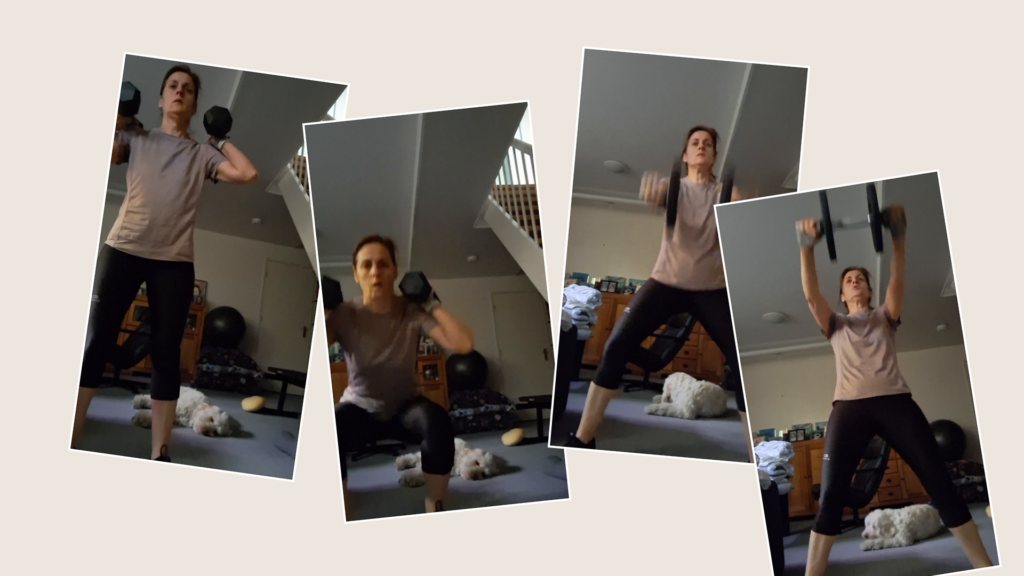
None of this requires hours in a gym or a complicated program. It requires starting, and starting with the right kind of training, which you can even do at home without any equipment, only a bit of space and some time (3 times a week 20 min to start with, increasing to 45 min in due time).
If a personal trainer session did not go anywhere before, it was rarely about effort. Generic programs are built for a general body, not for yours at this stage of life. Starting now, at any age, counts as starting on time.
My own training was very casual in my 30s and 40s. One gym session a week with a friend, more catching up than actual training. Later one class a week, zumba one month, body pump the next, whatever fit the schedule. It became serious once I understood why it mattered, and once a specific fear set in. I stopped trusting my body in ordinary moments, an icy sidewalk or a car trunk full of groceries, and two flights of stairs I could not climb without gripping the railing like my life depended on it. Once I decided that I wanted to be fit (read other newsletter on ‘’the moment’’), I moved to three sessions a week, then four, training at home with a growing set of weights and resistance bands strong enough to actually challenge me. It is planned in my agenda before my workday starts, every time. Having the time and the space for that is a privilege I do not take for granted, and it is exactly what I work through with my clients, finding the version of thirty minutes, three times a week, that fits into their life.
If you want a clear picture of where your body is starting from and what it specifically needs, the DEBs WAY Insight assessment is one form to fill, one call with me and one written report, no program commitment required. You’ll get clarity on your current muscle mass, bone readiness, and the exact starting point for strength training your body needs. Link in the comments.