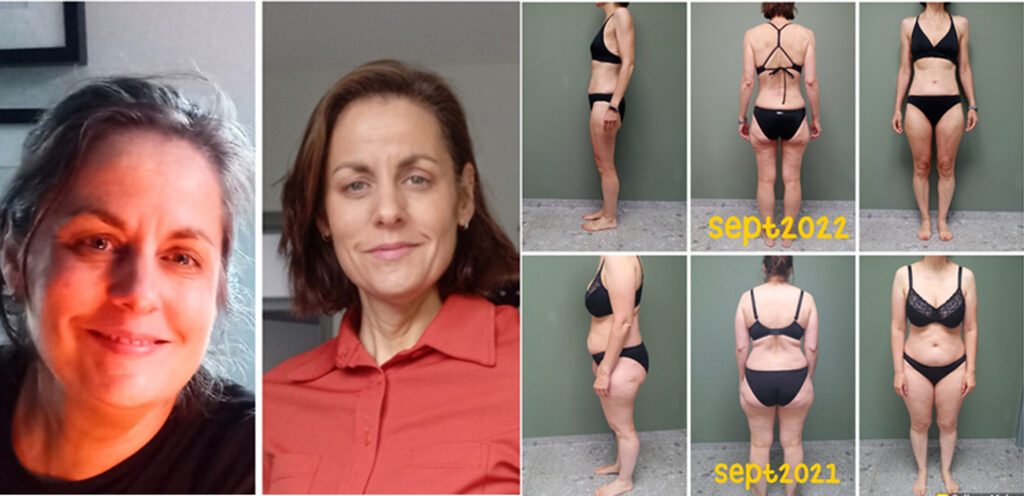


Running after menopause has completely changed how I think about training. My hubby looked at me with that face. The one you can’t say no to. We were standing in our kitchen, talking about the marathon in Leiden. Our 26th wedding anniversary was falling on race day, 10th May 2026.
I didn’t want to run another full. I’d done the math: training time, recovery load, my clients at DEBs WAY, my work at Ecotone. I just didn’t have the time and I didn’t want to put my body through it either.
So I said no. He kept looking.
In the end we made a deal: he runs the full, I run the half. What I didn’t realize was that we would also train separately. My 16-weeks training plan included 3 runs per week which I would be doing on my own.
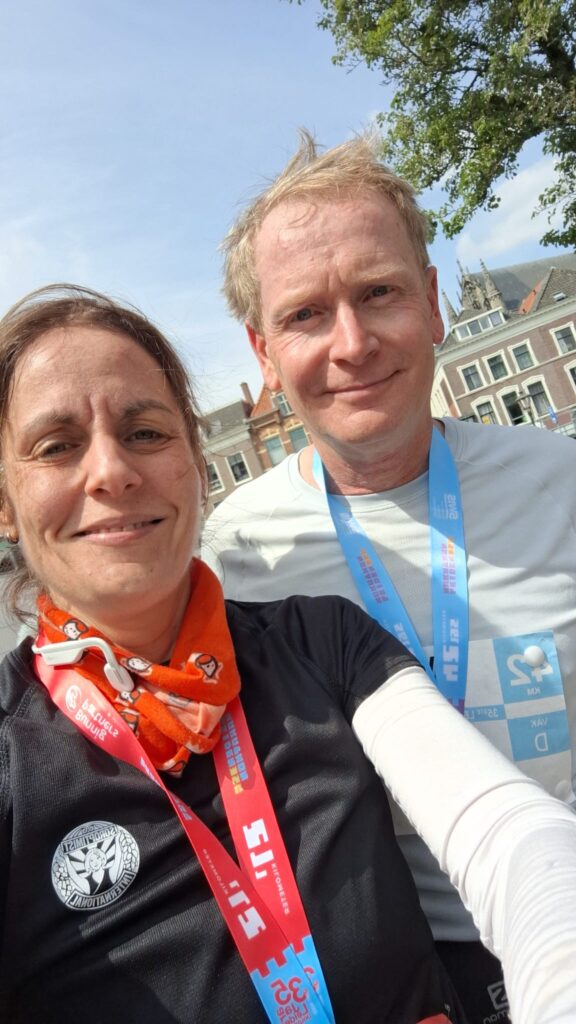
Two days ago I crossed the finish line. He started 1.5 hours earlier and came in about 30 minutes later. I stood at the end and felt proud. Not of the time or the distance, but of the fact that I protected the three things that actually matter for my health while I trained.
How I Got Here
I wasn’t a runner. My neighbor challenged me to run a marathon. I said: start with 5K. I did a Couch to 5K plan that got me up to 30 minutes running. I asked my husband to run my first race with me, and then we became running partners.
- May 2022: 5K in Leiden Marathon.
- May 2023: Half marathon, run-walk. We felt we cheated because we didn’t run the whole way. It bothered us enough to sign up again.
- September 2023: San Sebastian, Spain. Ran the whole thing to prove it to ourselves.
- May 2024: Full marathon in Leiden. 5 hours 30 minutes. The weather was brutal but we finished anyway.
- March 2025: Injured. Barcelona was cancelled for me. My daughter ran with my hubby instead. I watched with pride but also resignation.
- May 2026: Two days ago. The half marathon. My first solo.
Why I Run
People assume I’m chasing times or training for something, but I’m not.
Running after menopause changed how I relate to my body. It’s one moment, completely alone with myself. Step by step forward. No phone. No thinking about clients or what’s for dinner. Just breath in, breath out. It’s my meditation. The only time I’m not responsible for anything except the next step.
The races are different. They’re 100% mental challenge. I’ve trained. I know what my body can do. But the mind plays games the moment I’m on the course. This last race, running alone without my hubby pacing me, was the hardest one I’ve done. I loved it.
What Doesn’t Change
I run. I run longer distances sometimes. It takes hours per week. And still, I don’t let that come at the cost of three things.
Eating properly
At my age, my body needs around 100 grams of protein per day, give or take depending on body weight. I also eat 500 to 800 grams of vegetables and fruit per day, which give me micronutrients, satiety, and dietary fiber. I use healthy oils in moderation: olive oil, avocado, nuts, fish. And the calories match what I’m actually doing. When I run 75 minutes, I eat more. When I rest, I adjust.
This isn’t about being “perfect” with food. This is about eating intentionally and planned. Emotions stay out of my plate. I know what my body needs, and I give it that. And yes, I do enjoy ice cream, pasta, or a piece of cake sometimes. Not as a prize. Just as a pleasure, because I’m human and we do enjoy our food.
Strength training
30 to 45 minutes, 3 to 4 times per week. Because at 56, post-menopausal, muscle is everything. It’s what will keep my bones strong and what will keep me independent as I grow older, so I am able to carry groceries, pick things up, climb stairs without thinking about it.
NEAT, recovery and rest
Also very important for mental and physical health. Attention to general movement (about 70,000 steps per week), enough quality sleep, and real rest. Time where my body isn’t under stress and can recover to take on the next tasks.
What I See in My Practice
Women that come to me have different levels of commitment and understanding of what it takes to keep up with their nutrition and wellbeing.
Most women are not following a coherent system aligned with their needs in peri- and menopause. Decisions on food are usually taken based on what’s happening around them. Rest and relaxation happen whenever possible. Training is planned, but it’s often the wrong plan for this age: too much aerobic work or social play (tennis, paddle), and little to no strength training.
So basically, the foundation is missing. And then everything else goes sideways.
The Foundation
After 40, women’s bodies don’t tolerate incomplete systems. They won’t.
Three things have to come first.
- Eating properly (protein, fiber, enough calories).
- Strength training (3 to 4 times per week).
- Movement, sleep, and real rest.
The running – my 60 to 75 minute long run, my 30 to 40 minute short run – sits on top of that foundation. It’s what I choose because it feeds my mind and my marriage and my resilience.
Running after menopause is possible. But only because the foundation is solid.
If you’re ready to understand what eating properly means for your body, what strength training actually requires, what recovery needs to look like, let’s talk.