

“Not impossible. You will need to be very intentional.”
That is what I told a prospective client last week when she mentioned she was vegetarian. We had just been talking about protein, about how much women in perimenopause actually need versus what the Dutch Health Council recommends, and about why that gap matters more than most women realize. And then she added that one detail, and the conversation shifted.
The number nobody is talking about
I tell in discovery calls about my 8-week program that in perimenopause or menopause, the standard protein recommendation is not enough for what our bodies need. The Dutch Health Council advises 0.83 grams of protein per kilogram of body weight per day.
That number was derived from nitrogen balance studies conducted primarily in young adult men, and it tells you the absolute minimum your body needs to avoid breaking down. It says nothing about what a woman in her late forties or fifties needs to preserve muscle mass, manage body composition, or stay strong and functional, which are processes we must manage as estrogen declines.
The number I recommend is 1.6 grams per kilogram per day, which is what current research increasingly supports as a meaningful target.
She listened carefully. And we continued our conversation and arrived at her own eating patterns. And only then she mentioned that she is a vegetarian.
Not all protein is equal
Being vegetarian is a choice, and it is a choice I respect entirely. What is important is that the food you eat is actually delivering what your body needs, in sufficient quantity and quality, to do what you are asking it to do.
And that becomes genuinely complicated when you are a vegetarian woman over 45.
Here is why. Not all protein works the same way in the body. Animal protein, meaning eggs, dairy, fish, and meat, arrives with a complete amino acid profile and a high bioavailability rate, which means your body can use most of what you eat.
Plant protein is different. It is generally lower in bioavailability, often incomplete in its amino acid profile, and requires more deliberate food combining to deliver the same functional result. The Dutch Health Council already acknowledges this gap: vegans are officially advised to eat approximately 30 percent more protein than the standard recommendation precisely because plant protein is less efficiently used by the body.
Vegetarians who eat eggs and dairy are in a better position, but the gap does not disappear entirely, and it requires a level of attention that vegetarian women are not always giving themselves.
Protein alone is not enough
Now here is something the research has clarified in recent years, and I think it is important to say it plainly: eating enough protein alone is not enough.
There is a phenomenon called anabolic resistance that occurs during perimenopause and menopause. What it means in practice is that your muscles become less responsive to the signals that would normally trigger muscle protein synthesis, including dietary protein and resistance exercise. Your body works harder to ignore the things that are supposed to help it rebuild.
And what the research tells us is that to move the needle on muscle mass and strength, protein and resistance training need to work together. One without the other produces a significantly smaller effect than both combined.
Recovery is not optional
And then there is recovery. Sleep is not optional in this equation. During sleep, your body does the actual work of rebuilding the muscle tissue that training breaks down and that protein supplies the material for.
Research has shown that sleep restriction downregulates the molecular pathways responsible for protein synthesis in skeletal muscle. You can eat the right amount of protein and train consistently and still undermine the entire process if you are not sleeping.
For women in perimenopause, who are often dealing with disrupted sleep as one of the first and most persistent symptoms of hormonal change, this connection between recovery and results is a very important part of the picture.
Your choice, your trade-offs
So when my client told me she was vegetarian, what I heard was not an obstacle. What I heard was a set of trade-offs that deserved to be looked at honestly, without judgment and without pretending the tension does not exist.
I noticed something shift during our conversation. She came in a little guarded, visibly uncomfortable when the numbers came up. By the end she was curious, asking specific questions about what was actually possible within her own eating pattern. That shift is exactly what I am there for.
I do not make these choices for the women I work with. What I do is make the trade-offs visible, so that the choice, whatever it turns out to be, is a true choice and not something that happens by default without noticing.
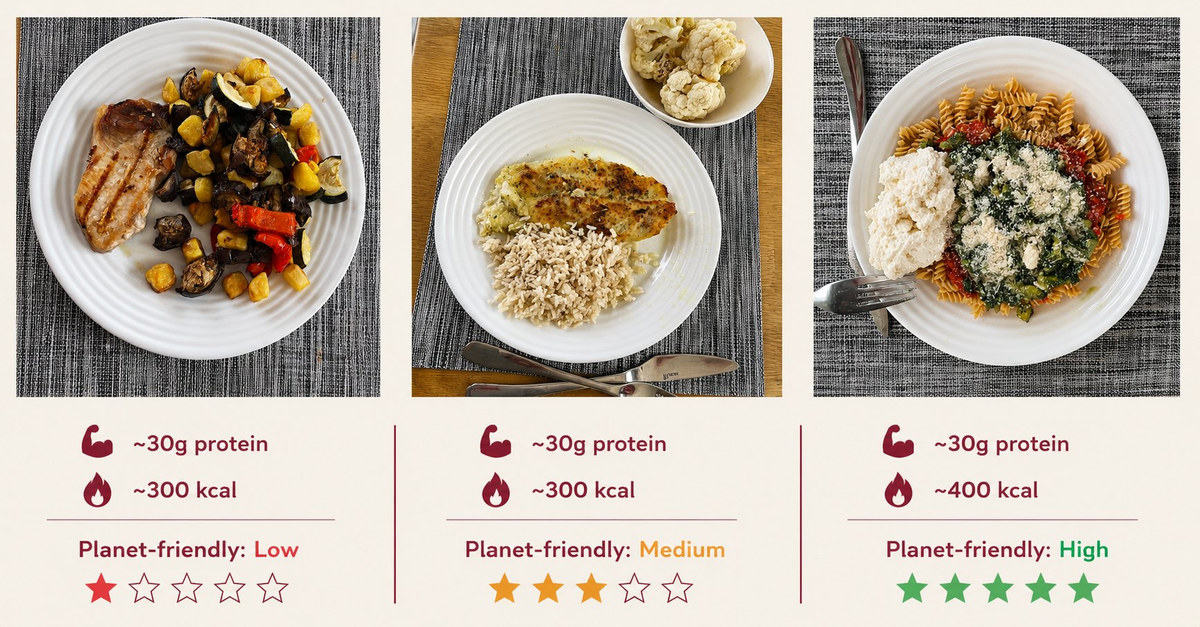
If she wants to prioritize the planet, here is what that means in practice: every meal needs to be deliberately constructed, not just assembled from whatever is convenient. Legumes, tempeh, eggs, Greek yogurt, cottage cheese, combinations that together deliver complete amino acids across the day in sufficient volume to get anywhere near 1.6 grams per kilogram. It is absolutely possible. It requires more planning than most women expect when they first sit down and look at the numbers.
If she wants to make some room for her body, it does not mean abandoning her values. It might mean being strategic about where animal protein fits, an egg at breakfast, dairy across the day, while keeping the rest of her plate plant-forward. A middle ground that is honest about what it involves rather than pretending the tension does not exist.
There is no wrong answer here. There is only the answer she feels comfortable with.
Where to start
If you are a vegetarian woman over 45 and you have never sat down and actually calculated how much protein you are eating versus how much your body needs right now, that is the place to start.
If you want to do that together and discuss the possibilities, you know where to find me.
Sources
0.83 g/kg Dutch Health Council recommendation and vegan +30% adjustment: Gezondheidsraad. Voedingsnormen voor eiwitten. Den Haag: Gezondheidsraad, 2021.
1.6 g/kg target for muscle hypertrophy: Stokes T, et al. Recent Perspectives Regarding the Role of Dietary Protein for the Promotion of Muscle Hypertrophy with Resistance Exercise Training. Nutrients. 2018;10(2):180. https://www.ncbi.nlm.nih.gov/pmc/articles/PMC5852756/
Plant protein bioavailability and amino acid profile: Gezondheidsraad achtergronddocument eiwitkwaliteit 2023. Verify before citing publicly.
Anabolic resistance in perimenopause and menopause: Gatorade Sports Science Institute. Muscle Protein Metabolism and Protein Requirements for Female Athletes. 2023. https://www.gssiweb.org
Protein plus resistance training combined superior to either alone in postmenopausal women: Ioannidou P, et al. Analysis of combinatory effects of free weight resistance training and a high-protein diet on body composition and strength capacity in postmenopausal women. Journal of Nutrition Health and Aging. 2024. https://www.ncbi.nlm.nih.gov/pmc/articles/PMC12877237/
Sleep restriction and muscle protein synthesis pathways: Supporting evidence from bioRxiv preprint and Physiological Genomics. Verify the specific claim before citing publicly.